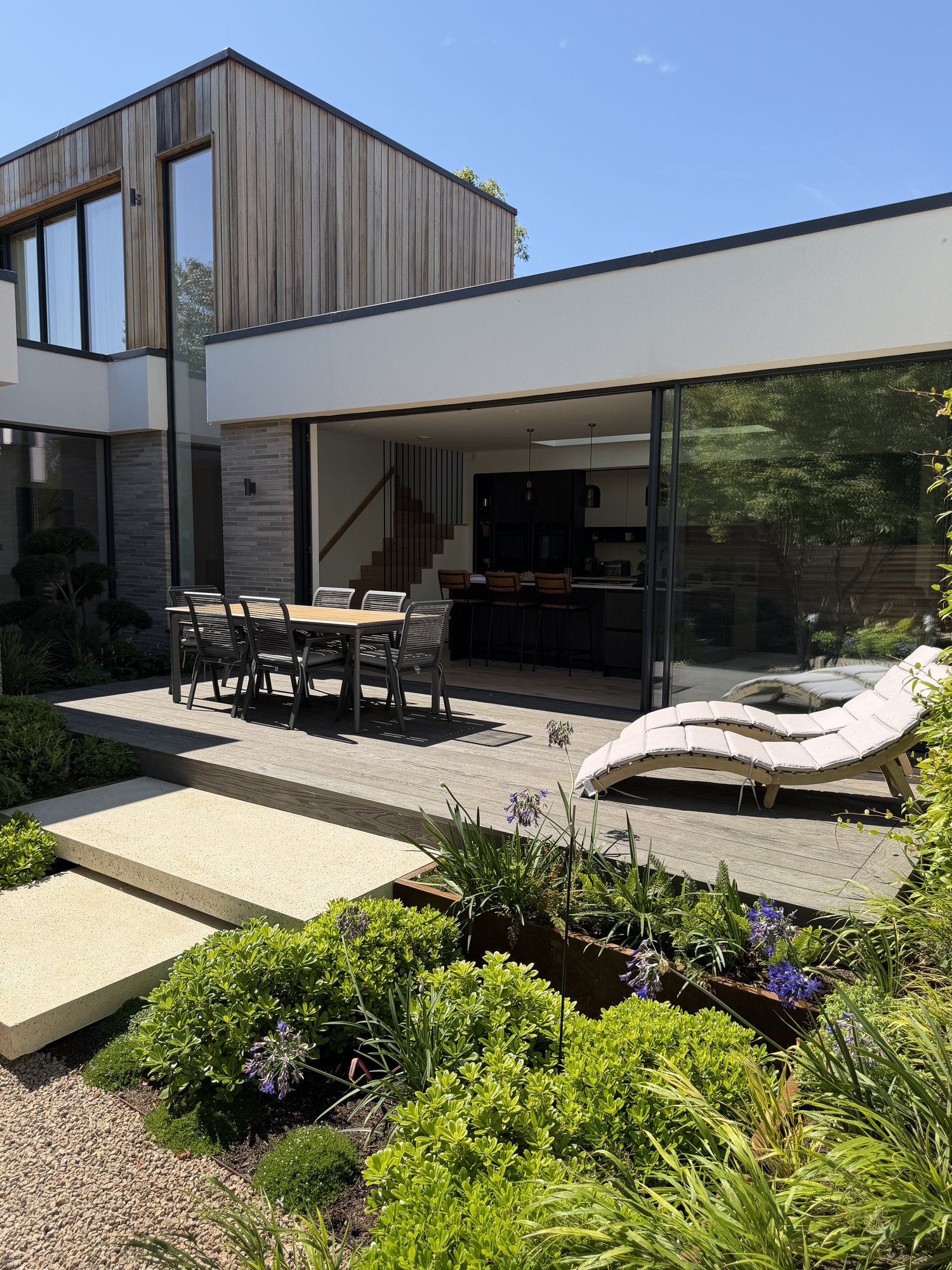
Garden design and construction in Bishop’s Stortford
Our home town. For twenty-six years we have designed and built gardens from Windhill to Thorley — courtyards, Victorian plots and two-acre gardens alike.
Conway Landscapes was founded in Bishop’s Stortford in 2000, and the town is still where most of our gardens are. From period houses around Windhill and the conservation area near the town centre, to Victorian terraces off Hadham Road, larger plots in Thorley, and the new estates of Bishop’s Stortford North and St Michael’s Hurst — we have designed and built in almost every street type the town has.
That local ground matters. The clay here shrinks in dry summers and swells in wet winters; the Stort navigation keeps the riverside air damp; and the conservation area brings consent considerations that we plan for at drawing stage, not after.
From new-estate plots to two-acre gardens
North of the town, the new estates at Bishop’s Stortford North and St Michael’s Hurst come to us with the same problem: compacted subsoil, thin turf, and a fence-to-fence rectangle. Our work there is about structure — planting schemes that give the plot bones, terrace design sized for how the household eats outside, and soil that is genuinely improved before anything is planted.
Around Windhill and the town centre, period gardens are smaller and more sensitive: paved courtyards, side-return seating, and planting that softens brick without hiding it. Further out towards Hadham Road and Thorley, plots open up — room for outdoor kitchens, lawn, and garden rooms at the end of the plot.
Clay, conservation and Castle Park
Bishop’s Stortford sits on Hertfordshire clay, so drainage design is not a nice-to-have here — it is the difference between a terrace that holds and one that heaves. We design land drainage and falls into every scheme, and on the slopes towards the Stort and Castle Park we keep levels and run-off in check with the neighbours in mind.
If your house is in or near the town-centre conservation area, hard landscaping and walls can need consent. We prepare those applications as part of the design, through East Herts Council’s planning service, so nothing stalls at the last step.
Do you work with the clay soil in Bishop’s Stortford?
Every week. We improve or replace soil on new estates, design drainage for the heavy ground, and choose plants that thrive in it. Our journal piece on clay gardens explains the approach.
My house is in the conservation area — is that a problem?
No, but it needs to be designed for. Walls, hard landscaping and significant level changes may need consent, and we handle the application as part of the design process.
Can you design a small garden in the town centre?
Many of our Stortford projects are courtyards and side-return gardens under 100 square metres. Small gardens reward good design more than large ones — see our notes on small gardens with big impact.
How far will you travel from Bishop’s Stortford?
The town is our base, so most of Hertfordshire and north Essex is within half an hour. We regularly work in Sawbridgeworth, Harlow, Much Hadham and up towards Saffron Walden.
Who looks after the garden once it is built?
No — we are purely a design and build company. We plant schemes that need very little care and leave you a simple guide for the first two years.
Stansted Airport is close by — can you reduce the noise?
Planting and structure can take the edge off: solid boundary fencing, dense hedging and water features change how a garden sounds. It is a common request around the flight path.
Start your project
Arrange a design visit and we will walk the garden with you, listen to how you want to live in it, and set out what a design and build would involve.